

Clive Churchill: The Little Master Who Redefined Rugby League
Clive Churchill is widely regarded as one of the greatest Rugby League players to ever grace the game, a figure whose influence on the sport, and on the South Sydney Rabbitohs, remains unmatched.
Churchill arrived at South Sydney in 1947 after rising through the Newcastle competition, making his first-grade debut at fullback in the number 18 jersey. Even in a narrow 25-20 loss to Newtown, he made an immediate impression, kicking three goals and showcasing a style of play that would soon revolutionise the position.
With the ball in hand, Churchill played unlike any fullback before him. He was unpredictable, creative, and constantly in support, a playmaker in an era when fullbacks were largely last-line defenders. His ability to read a game, spark attacking movements, and turn half-chances into opportunities, helped to reshape the role forever.
Defensively, he was just as remarkable. At only 176 centimetres tall and under 80 kilograms, Churchill regularly chopped down opponents more than twice his size. His cover defence became hallmarks of his game, earning widespread admiration.
In only his second season, Churchill debuted for City, New South Wales, and Australia, an extraordinary feat given South Sydney finished outside finals contention that year. In 1950, he earned the Australian Test captaincy, guiding the Kangaroos to their first Ashes victory over Great Britain in over three decades.
Throughout the 1950s, Churchill stood at the centre of South Sydney’s second great golden era. He led the Rabbitohs to premierships in 1950, 1951, 1953, and 1955, earning his nickname “The Little Master” by legendary forward Ray Stehr. By the time he finished his South Sydney career, Churchill had played 157 career games and four premierships, cementing his status as one of the game’s true champions.
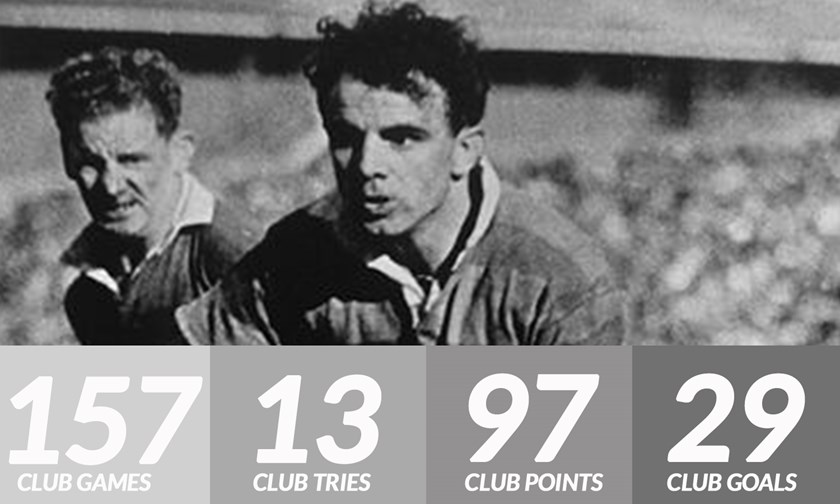
After retiring as a player, Churchill remained connected to the Club, working as a taxi driver in Sydney before returning as head coach in 1967. His influence proved just as powerful from the sideline. Over five seasons, he coached the Rabbitohs to four premierships, helping shape the legendary careers of John Sattler, Ron Coote, Bob McCarthy, and Eric Simms.
In 1981, Churchill was named one of Rugby League’s inaugural Immortals, an honour reserved for the game’s most influential figures. In 1985, he was awarded the Order of Australia Medal for his service to Rugby League.
Churchill sadly passed away in 1985 after a long battle with cancer, with thousands gathered at St Mary’s Cathedral to farewell a man whose impact stretched far beyond the field.
His legacy remains woven into the fabric of Rugby League. Since 1986, the Clive Churchill Medal has been presented to the player judged best on ground in the Grand Final, a fitting tribute to a man whose brilliance shaped generations.
Clive Churchill was more than a champion. He was a pioneer, a leader, and an icon of Australia’s oldest and proudest Rugby League Club.
A legend whose influence endures, and a reminder of why, since 1908, South Sydney is still here.
CAREER MILESTONES
| Premierships | 1950-51, 1953, 1954 |
| Kangaroos' Tour Captain | 1952-53 |
| Kangaroo Tours | 1948-49, 1952-53, 1956-57 |
| Australian Captain | 27 Tests |
| NSWRL Player of the Year | 1950-51, 1953 |
| Sun-Herald Best and Fairest | 1952 |
| Grand Final Man of the Match | 1954 |
| Immortal | 1981 |
| Australian Rugby League Team of the Century | 2008 |
| New South Wales Team of the Century | 2008 |
| NSW Country Team of the Century | 2008 |
| Rated No.1 in Rugby League Week's Top 100 Players | 1992 |
| Named in NRL Team of the 1950s | 2007 |


