
20 Years of Souths Cares: Deadly Youth Program
This year marks 20 years of Souths Cares, a charity built on the South Sydney Rabbitohs' long and proud history of supporting the community. Since its establishment in 2006, Souths Cares has supported disadvantaged and marginalised young people and their families, with a strong focus on Aboriginal and Torres Strait Islander communities.
Today, the charity engages more than 35,000 individuals each year through programs focused on education, training, health, and employment needs; empowering young people to achieve their dreams and aspirations.
SUPPORT THE WORK OF SOUTHS CARES BY MAKING A DONATION HERE
As part of our Souths Cares: 20 Stories for 20 Years series, we're looking back at the moments, people and programs that have shaped Souths Cares.
This story looks at the Deadly Youth Mentoring Program, launched in 2018 to support young Aboriginal people who needed someone in their corner, and now it's one of the most meaningful programs Souths Cares runs.
In New South Wales, Aboriginal young people make up approximately 45 per cent of all young people in custody, despite representing a small fraction of the overall population. They are around 27 times more likely to be incarcerated than their non-Aboriginal peers.
It was in response to those figures that Souths Cares launched the Deadly Youth Mentoring Program in August 2018, with the support of the NSW Government. The then-NSW Attorney General attended Rabbitohs HQ to officially launch the program alongside Rabbitohs legend Greg Inglis and Club CEO Blake Solly.
The idea was simple but powerful: pair at-risk Aboriginal and Torres Strait Islander young people aged 10 to 17 with a dedicated mentor, and walk alongside them before things got to a point where the only option left was the justice system.
"I think it was a response to the Closing the Gap initiative, especially around education and crime," said Mel Taufa, one of the program's mentors. "The police were looking for a different avenue to engage with the kids. Programs like the Deadly Youth Mentoring Program gave them that."
Referrals come from all sorts of places including schools, police, parents, medical centres, and community services. Once a young person joins, they meet with their mentor every week for six months, with every session shaped around what that particular young person is working through.
"Whatever their goals are, that's where we take it," Taufa explained. "If a kid is struggling to get to school on time, we can help with transport. If they have learning challenges, we can sit in class with them. It's different for every person."
The role goes well beyond weekly sessions. Buddy Gordon, who leads the Deadly Youth Mentoring Program, and Mel Taufa, who leads the female mentoring stream, act as the link between families, schools, and social services.
"Families will let us into their homes when they won't let anyone else in," Taufa said. "Building that trust is everything."
Being Aboriginal themselves, Buddy and Mel bring an understanding to the work that goes beyond professional training. Connecting young people to their culture is central to that.
"Engaging kids in cultural activities brings out a real pride in them," she said. "They don't have to be ashamed of who they are or where they come from."
One young woman who came through the program put it simply.
"It's just good to know where you came from. Being connected to your culture is something really deep. The program introduces you to more than what schools are showing you."
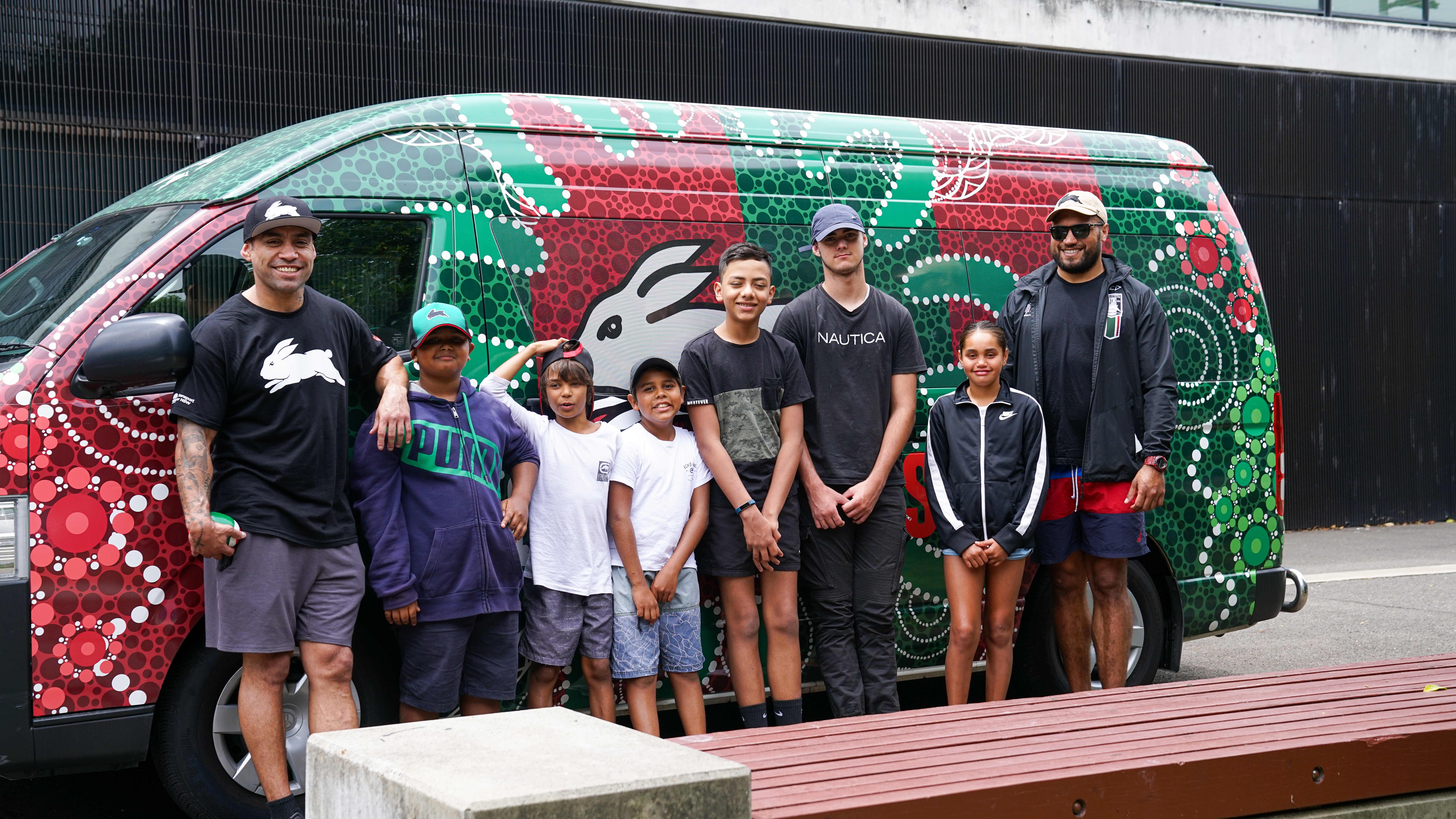
The Rabbitohs connection adds something few programs can offer. Young people who are consistently showing up get access to experiences money cannot buy, including game days, time with players, and gear.
"Some of the players are Indigenous. Some of them grew up in Redfern and Waterloo, in similar situations to the kids in the program right now," Taufa said. "That makes them role models in the deepest sense."
The work is not always easy. Mel has seen food insecurity, family instability, and young people stealing just to get through the day. For many, the program is the last stop before something much harder.
"If this program doesn't work, the next step is juvie," Taufa said. "The program has helped a lot of kids stay out of there and get back on track for themselves and their families."
When the program launched in 2018, Buddy ran it alone. Over time it became clear that one mentor could not appropriately support both young men and young women, and Mel came on board as the female mentor. Since then the program has grown significantly, expanding its reach, its referral pathways, and its activities, including the Deadly Boys 2 Deadly Men group and the Our Ways Our Stories TAFE course.
As Souths Cares turns 20 this year, the Deadly Youth Mentoring Program stands as one of the clearest examples of what this organisation was built to do.
"We've connected to so many kids and changed so many lives," Taufa said. "The fact that we keep getting the funding tells you there's a real need, and that what we're doing is actually working."
One young woman who came through the program and now works for Souths Cares summed it up simply.
"Even just Mel pushing me a little bit, that's what pushed me to why I now have a job. Even that little help made that much difference."
As long as young people in this community need someone in their corner, the Deadly Youth Mentoring Program will be there.


